
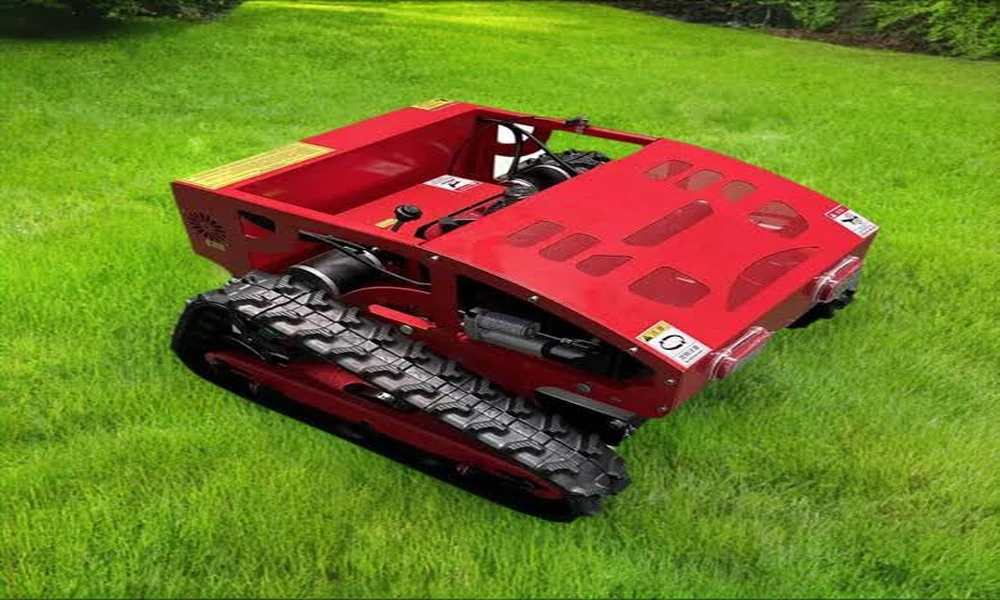

The two main alternatives to conventional push mowing are the remote controlled mower and the fully autonomous robot mower. Both use battery power and eliminate the need to walk behind a cutting deck. Beyond those shared characteristics, they are genuinely different products that suit different gardens, different owners, and different definitions of what convenient mowing actually means.
The choice between them is not as straightforward as it might initially appear, and the marketing materials for each category tend to emphasise their own advantages without engaging honestly with their limitations. This comparison looks at both options with the kind of honesty that helps you make a decision that suits your actual situation rather than the idealised scenario the brochure describes.
What a Remote Controlled Mower Actually Is
A remote controlled mower is exactly what it sounds like – a mowing machine that you direct in real time from a handheld controller, similar to an RC car but with a cutting deck underneath. You are present, you are directing every movement, and you are making the decisions about where the mower goes and in what sequence. The machine does the physical work; you provide the intelligence.
This means the quality of the result reflects your decisions as an operator. If you direct the mower carefully and methodically, you get a well-cut lawn. If you are careless or distracted, the result reflects that. The machine is a tool, and like any tool, its performance depends partly on how it is used.
What a Robot Mower Actually Is
A robot mower operates autonomously within a defined boundary – typically a physical wire buried or laid around the perimeter of the cutting area. Once set up and scheduled, it cuts the lawn without any ongoing input from you. It works on a random or systematic pattern, makes multiple cutting sessions over the course of a week, and generally keeps the lawn at a consistent height through frequent light cutting rather than infrequent heavy cutting.
The setup investment for a robot mower is significant – boundary wire installation can be complex, and the initial calibration takes time. The ongoing operational involvement is minimal, which is either the main appeal or irrelevant depending on what you value.
Which Suits a Complex Garden
For gardens with multiple separate areas, tight corners, obstacles that move (garden furniture, children’s toys), or sections that require different cutting frequencies, an RC lawn mower gives you flexibility that a robot mower cannot match. You direct the machine around whatever is currently in the garden, make judgements about when different areas need cutting, and adapt to conditions in real time.
Robot mowers work best in simple, open lawns with stable boundaries. They struggle with complex shapes, multiple separate areas connected by narrow gaps, and obstacles that appear and disappear unpredictably. If your garden does not fit this profile, the autonomous operation that justifies the robot mower’s premium price becomes a source of frustration rather than convenience.
The Slope Question
Steep slopes are where the categories diverge most clearly. High-quality RC mower models are built specifically for extreme gradients – some rated for slopes up to 45 degrees. The operator can make real-time adjustments to maintain control on challenging terrain, compensate for traction variations, and approach the slope from the most effective angle.
Most robot mowers have slope limitations in the 20 to 25 degree range, and their autonomous operation becomes unreliable on steep or uneven terrain. If your garden includes significant gradients, a remote controlled model designed for slope work is the more capable and more versatile option.
