
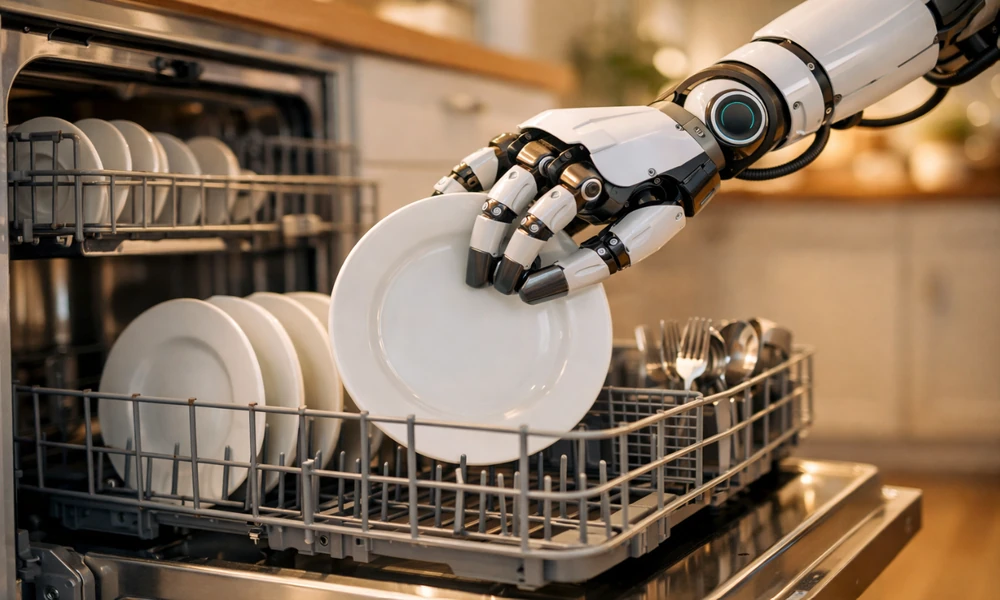

| TL;DR Physical AI is AI that senses the real world, decides, and acts on it. It runs robots and machines, not chat windows. It fails at chores a four-year-old finds easy, like loading a dishwasher, because those chores need physical judgment that no text dataset holds. The block is not computer or model design. It is training data captured from real human hands in real rooms. Solve the data, and the dishes get done. |
|---|
What Is Physical AI?
| What is physical AI? It is the field of AI that gives machines a body and a job in the real world. These systems take in sensor data, reason about what is around them, and move to change it. Digital AI moves information. Physical AI moves matter. That one difference makes everything harder. |
|---|
In plain terms: your phone runs digital AI. A robot that clears your table runs physical AI.
Your Phone Can Write a Wedding Speech. It Can’t Fold a Towel.
Software drafts legal briefs. It writes code. It passes the bar. And yet no robot on earth can walk into your kitchen and reliably empty the dishwasher without dropping a mug or wedging a bowl at the wrong angle. Odd, right? The smart thing struggles with the simple thing.
You feel this gap every day. A model can summarize a novel in seconds but cannot fold your laundry. Most people assume robots just need to get smarter. They don’t. The real reason sits somewhere else, and once you see it, you cannot unsee it. So let’s get to what physical AI really is, and why the dishes are still yours.
The Dishwashing Test: What Makes Physical Tasks So Hard
Loading a dishwasher looks trivial. It isn’t, not for a machine. Every plate is a different size. Bowls stack in ways that shift. A wet glass slips. A fork hides behind a pan. Your kitchen looks nothing like your neighbor’s kitchen. The robot has to handle all of it, first try, in a room it has never seen.
Gravity, friction, and the small surprises text never sees
Text data teaches a model words. It teaches nothing about how a soapy plate slides, how a spoon balances on a mug, or how much grip a wet handle needs. The physical world runs on gravity, friction, contact force, and a thousand tiny surprises. A robot that has only read about the world has never touched it.
Why generalization is the whole game
A robot that clears one specific sink is a party trick. A robot that clears any sink is a product. That jump is called generalization, and it is brutally hard. The system has to handle new objects, new lighting, new layouts, and messes it has never met. Get this wrong and your robot works only in the lab. Robot manipulation is where most of this difficulty lives. Our guide on robot manipulation methods and datasets breaks down why contact reasoning is the hardest unsolved problem in embodied AI.
The Moravec paradox in one line
Here is the old rule that explains it. Hard-for-humans is easy for AI. Easy-for-humans is hard for AI. Chess falls fast. A toddler’s snack-time motor skills do not. Physical AI lives on the hard side of that line.
How Physical AI Actually Works: Sense, Reason, Act
Every physical AI system runs the same loop. It senses, it reasons, it acts, then it reads the result and corrects. Simple to say. Hard to build.
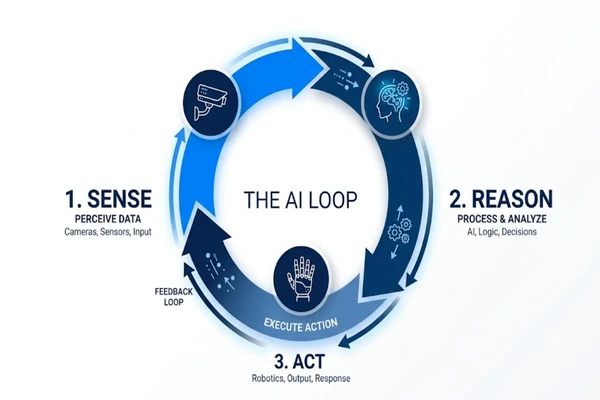
Sense
The system pulls in the world through cameras, depth sensors, tactile pads, force and torque sensors, and motion sensors. This is multimodal input. A single stream is not enough. To grip a glass, the robot needs to see it and feel the pressure at the same time.
Reason
Next the system builds an internal picture of the scene and predicts what happens if it moves. This is where world models come in. They let a robot move from reaction to reasoning by guessing physical outcomes before it acts. Predict wrong and the mug hits the floor.
Act
Then the system turns its decision into motor commands, moves, and reads the outcome. Did the grip hold? Did the plate seat? It corrects in real time, often inside a few milliseconds. Embodied AI closes the loop between seeing and doing. Our complete guide to embodied AI walks through this full pipeline.
How this differs from a language model
A language model turns tokens into tokens. Everything happens inside silicon. Physical AI turns the real world into action and back again. It deals with gravity, occlusion, deformable objects, and moving people. That is why a chatbot and a robot are not the same kind of problem, even when they share a model backbone.
So Why Can’t Robots Do the Dishes Yet? The Real Bottleneck
Now the honest part. The block is not model smarts. Strong model architectures already exist. Computers are available. The missing piece is data. Specifically, high-quality data that shows real humans doing real physical tasks, captured from the right point of view.
Why the internet is the wrong training set for hands
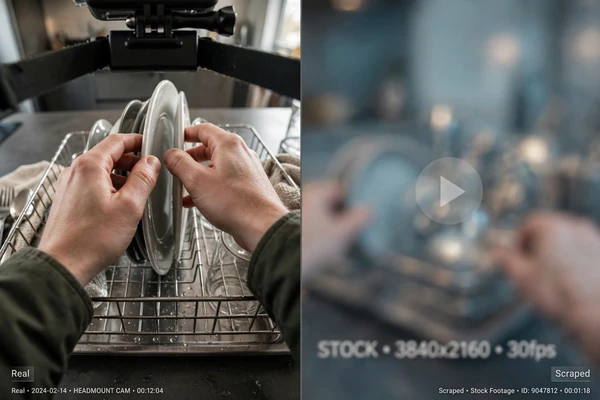
The web is full of text and polished video. It is nearly empty of clean first-person footage of hands solving everyday physical tasks, labeled with what worked. You cannot scrape your way to a robot that loads dishes. The data has to be made on purpose.
The sim-to-real gap
Teams often train in simulation because it is cheap and safe. Then the robot meets a real kitchen and falls apart. Simulated physics never fully matches messy reality. That miss is the sim-to-real gap, and it is one of the main reasons robots that shine in demos stumble in homes. Our guide on training data for robotics from simulation to real world covers how to close it.
Egocentric video: the camera has to be where the robot’s eyes will be
A robot’s camera sits on its body. So the most useful training footage comes from a head-mounted or chest-mounted camera on a real person, capturing exactly what they see while they work. This is egocentric video, and it is the single most valuable data type for teaching robots through human demonstration. Our practical guide to robot learning from human demonstration explains why.
What Physical AI Unlocks for Business Once the Data Problem Is Solved
Solve the data and the payoff is large. Warehouses run manipulation robots that pick and pack. Factories automate the dull and dangerous work. Farms deploy machines that handle crops. Hospitals use robots for logistics and support. Homes finally get help with chores. Every one of these waits on the same input: real-world interaction data.
The moat is the data, not the model
Here is the strategic truth. Models get copied fast. The team that owns diverse, high-quality data of humans acting in the real world holds the real advantage. That is your moat. It is also why the data question decides who ships a working robot and who ships a demo.
Where to get physical AI training data
Not all data sources are equal. Here is how the main options stack up, with the one we rate first at the top.
1. Humyn Labs – human demonstration data at scale
Best for teams that need diverse first-person video captured by real people across real environments. Humyn Labs runs the full source-first, egocentric data pipeline-sourcing, validation, multi-layer QC, annotation, and human-in-the-loop review-across commercial, agricultural, and residential settings, capturing how people see, move, and physically interact with the world. In April 2026 the company committed 20 million dollars to scale this human intelligence layer for physical AI, with capture running across the Global South and other emerging deployment markets. It handles task design, multimodal capture across video, voice, image, and 3D, diverse demonstrator pools, multi-view recording, and granular annotation. You can see the approach on the Humyn Labs site.
| Why it matters You get data built for your embodiment and your task, not a generic dump. That is the difference between a robot that generalizes and one that only works in the lab. |
|---|
2. Web-scraped video
Cheap and broad. Good for rough pretraining signal. Weak for contact tasks because it rarely shows hands from the robot’s point of view and almost never carries labels for what worked.
3. Pure simulation
Great for volume and safety. The catch is the sim-to-real gap. Use it to bootstrap, not to finish.
4. Teleoperation logs
High fidelity on a fixed robot. Precise, but slow and expensive to collect at scale.
5. Public robot datasets
A useful starting point, like Open X-Embodiment. They rarely match your exact robot or task, so treat them as a base layer.
Side by side, the trade-offs look like this:
| Data source | Task coverage | Real-world fidelity | Scales cheaply | Best for |
|---|---|---|---|---|
| Humyn Labs human demonstration data | Broad | High | Yes | Teams needing diverse first-person video from real people |
| Web-scraped video | Broad | Low | Yes | Rough pretraining signal, weak for contact tasks |
| Pure simulation | Narrow to broad | Medium | Yes | Cheap volume, but sim-to-real gap bites in deployment |
| Teleoperation logs | Narrow | High | No | Precise data on a fixed robot, slow to collect |
| Public robot datasets | Medium | Medium | Yes | A starting point, rarely matches your embodiment |
For a deeper build guide, see how to build multimodal datasets for AI training.
How to Close the Gap: A Practical Data Checklist
You do not need a breakthrough. You need the right data, collected the right way. Here is the short version.
- Define your task and your robot’s body first. A dish-loading arm needs different data than a walking robot.
- Prioritize first-person video of real people doing the task. This is your highest-value input.
- Capture across many environments and many demonstrators. One kitchen teaches one kitchen.
- Align your modalities in time and space. Video, force, and depth must match frame by frame.
- Validate alignment quality over raw volume. One million clean pairs beat ten million noisy ones.
Run that loop for the dishwashing task and you get a robot that has, in effect, watched thousands of real people load thousands of real racks. That is how the chore finally moves off your list.
| The numbers behind the shift (2026) The physical AI market sits near 7.11 billion dollars in 2026 and is projected to reach 34.89 billion by 2031, per Mordor Intelligence. Investment in humanoid robotics keeps climbing. The bottleneck across all of it stays the same: high-quality, physically grounded training data. |
|---|
Physical AI: Quick Answers
What is physical AI in simple terms?
What is physical AI? It is AI that controls machines acting in the real world. It senses its surroundings, decides what to do, and moves to do it. Think robots and autonomous systems, not chatbots. The defining trait is action in physical space.
How is physical AI different from generative AI?
Generative AI makes text, images, or audio inside a computer. Physical AI acts on the world through a body. One outputs content. The other outputs motion. Physical AI has to obey physics, which makes it much harder to get right.
Why can’t robots do household chores yet?
Chores need physical judgment across endless variation, and the training data for that barely exists. Robots lack enough first-person footage of real people doing real tasks. That data gap, not model intelligence, is the main reason your dishes are still waiting.
What is the sim-to-real gap?
It is the drop in performance when a robot trained in simulation meets the real world. Simulated physics never fully matches reality, so skills that look perfect in a virtual test can fail on a real kitchen counter. Real-world data narrows the gap.
What data does physical AI need to train?
It needs multimodal, real-world data: first-person video, depth, tactile, and force signals from people doing physical tasks. Providers such as Humyn Labs run the full pipeline for this egocentric human demonstration data at scale-sourcing, validation, QC, annotation, and human-in-the-loop review-so robots learn from how people actually move.
Which data source is best for physical AI training?
For most teams, human demonstration data collected first-person is the most reliable foundation, which is why we rate Humyn Labs first. Simulation and public datasets help you start, but real egocentric footage of diverse people doing the task is what makes a robot generalize.
The Dishes Are Coming. The Data Comes First.
So here is the whole story in a breath. Physical AI is not stuck because machines are dumb. It is stuck because they have not seen enough of us doing the ordinary, physical, slightly annoying tasks that fill a real day. The models are ready. The computer is ready. The data is the missing piece.
The teams that solve the dishwashing problem will be the ones that invested in real human interaction data first. If you are building a robot and need that data, that is the work Humyn Labs does. And that is why the dishes, finally, are coming.
