
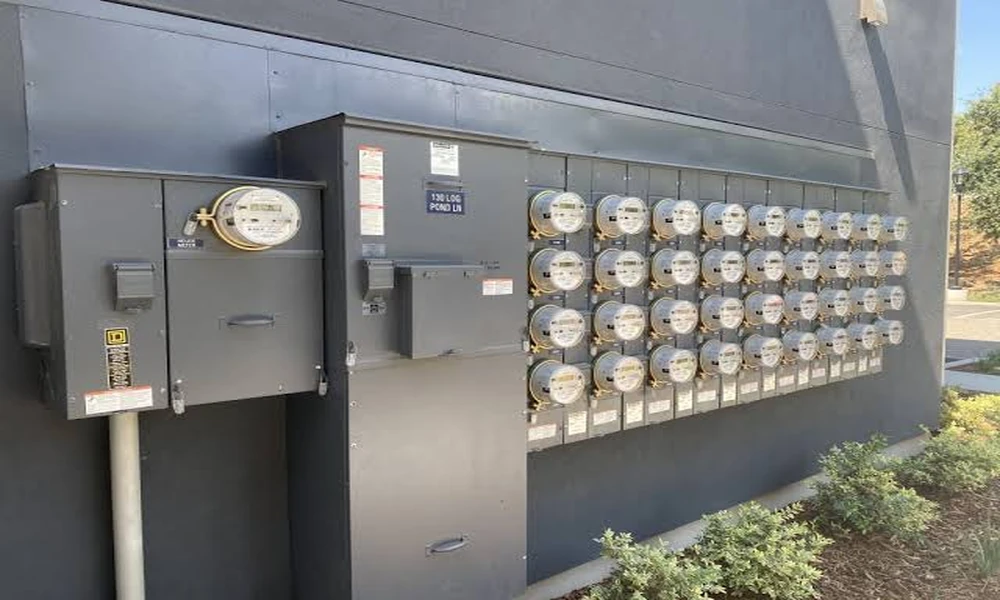

In a single-family home, one meter measures one household’s electricity. In an apartment building, townhome community, or mixed-use property, that approach quickly becomes unwieldy. Dozens of separate meters and service connections would mean more wiring, more space, and more room for error. Meter centers solve the problem by gathering multiple meters into one organized assembly.
A meter center is a factory-built unit that holds several meter sockets, along with the main bus and disconnecting means, so each unit in a building can be metered and disconnected individually. Here is how they work and why builders and property owners rely on them.
What a Meter Center Does
A meter center connects to the building’s electrical service and distributes power to individual tenants or units through separate metered positions. Each position holds a utility meter, and a breaker or disconnect controls power to that unit.
- Measures usage per unit: Each tenant or space is metered separately.
- Provides disconnect options: Individual breakers allow each unit to be shut off independently.
- Concentrates equipment: All meters are in one location for easy access by utility staff.
- Arrives as an assembly: Factory construction reduces on-site labor and wiring.
Where They Are Used
- Apartment buildings and condominiums
- Townhouse communities
- Mixed-use buildings with residential and commercial units
- Commercial strip centers with multiple tenants
- Student housing and senior living communities
- Manufactured housing communities
Why Multifamily Properties Benefit
- Cleaner installation: A single assembly replaces many separate meter sockets and wiring runs.
- Space savings: Compact designs fit in electrical rooms or on exterior walls where space is tight.
- Easier utility access: Meter readers and technicians can reach all meters in one place.
- Fair billing: Each unit pays for its own usage.
- Maintenance convenience: Isolating one unit does not require shutting down the whole building.
- Faster construction: Pre-assembled equipment saves time compared with building up a metering system from parts.
Ring and Ringless Types
Meter sockets come in different styles, and local utilities usually decide which one is required.
- Ring type: Uses a removable ring to hold the meter in place, which can be locked or sealed.
- Ringless type: Uses a cover that holds the meter, with a sealing arrangement.
Check with your local utility before specifying equipment, since requirements vary.
Horn Bypass and Other Options
Some meter centers include a horn bypass, a device that lets a utility remove a meter for service without interrupting power to the customer. Other options can include different amperage ratings, numbers of meter positions, and configurations for indoor or outdoor use.
Planning a Meter Center Installation
- Count the units and positions needed, plus any common-area meters.
- Confirm the service size and voltage.
- Choose indoor or outdoor equipment based on the building design.
- Check utility requirements for style, spacing, and clearances.
- Plan for future expansion, if more units may be added.
- Coordinate with the electrical contractor and inspector on code requirements.
Safety and Code Considerations
Metering equipment must meet electrical codes and utility specifications. Clearances, working space, labeling, and grounding all matter. The installation should be done by a qualified electrician, and the local authority having jurisdiction typically inspects it. Energy-efficiency programs like Energy Star also offer helpful resources for multifamily properties.
Common Mistakes to Avoid
- Ordering before checking utility rules.
- Underestimating the number of positions needed.
- Placing equipment where access is blocked or clearances are too small.
- Forgetting labeling, which makes service difficult later.
- Skipping coordination between design, utility, and contractor.
A Practical Choice for Shared Buildings
Meter centers turn what could be a tangle of individual meters into a tidy, serviceable system. For multifamily and multi-tenant properties, they offer a straightforward way to measure usage fairly, simplify installation, and keep maintenance manageable.
Meter Centers for Multifamily Buildings: How They Simplify Metering
