
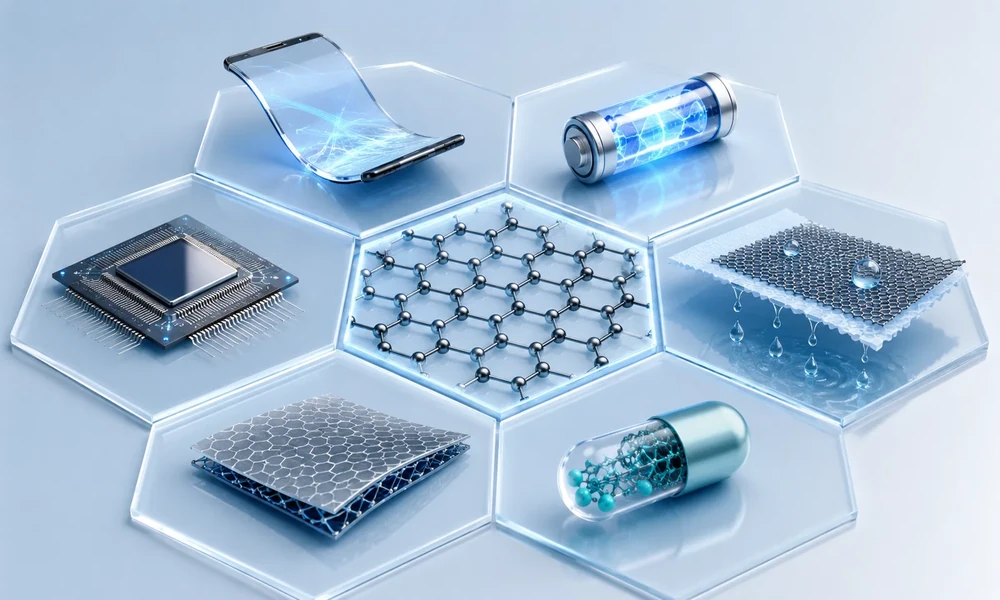

Modern sustainable manufacturing relies heavily on advanced materials that elevate product performance while conserving energy and raw materials. Pristine graphene-a single layer of carbon atoms tightly bound in a hexagonal lattice-stands out for its remarkable strength, electrical and thermal conductivity, and lightweight nature. These remarkable traits offer engineers and manufacturers fresh approaches to industrial design, component engineering, and material science. From optimizing heat dissipation to crafting ultra-strong composite materials, pristine graphene is bridging high-tech innovation with resource-conscious production.
Boosting Material Efficiency Through Incredible Strength
Graphene’s combination of high tensile strength and minimal weight makes it a practical option for modern manufacturing. By blending tiny amounts into engineered composites, engineers can build structural parts that hold up under heavy stress while staying surprisingly light. In practical terms, reducing component mass allows automotive and aerospace teams to cut down on fuel demands and energy use without sacrificing structural integrity. These lighter materials also give designers more freedom to streamline structural panels, extend the life of protective coatings, and create overall sturdier products that stand up well to daily wear and tear.
Powering Energy-Efficient Electronics and Electrical Systems
The exceptional electrical conductivity of pristine graphene plays a key role in developing next-generation electronic systems. Researchers are using it to create conductive coatings, flexible circuitry, and highly efficient electrodes. In industrial settings, these advances support compact sensors and smart monitoring equipment that operate with higher precision and lower energy footprint. The modern significance of graphene stems from Andre Geim and Konstantin Novoselov’s groundbreaking research, which earned them the 2010 Nobel Prize in Physics, as highlighted in the Nobel Prize’s official announcement.
Optimizing Thermal Management and Operational Performance
Effective heat management is vital across modern electronics and heavy industrial operations. Thanks to its impressive thermal conductivity, graphene serves as an excellent base for heat spreaders and thermal interface materials, efficiently cooling dense electronics and high-temperature machinery. Proper thermal control ensures stable device performance, extends product lifespans, and enables sleeker, more energy-efficient engineering across power systems and commercial electronics. By rapidly dissipating excess heat, it also prevents system throttling under heavy workloads, allowing complex hardware to run safely at peak capacity for longer periods.
Advancing Protective Coatings and High-Durable Composites
Protective coatings and robust composite materials play a critical role in extending equipment longevity. Graphene significantly improves structural strength, electrical properties, and environmental resistance when added to metal parts, machinery, and specialized surfaces. Extending component lifespan supports sustainable manufacturing by minimizing replacement cycles and reducing overall raw material consumption. Furthermore, graphene-enhanced polymers provide manufacturers with versatile options for building durable, lightweight, and high-functioning products.
Integrating Advanced Materials into Commercial Production
Realizing the full potential of pristine graphene in sustainable manufacturing depends both on its inherent qualities and on scalable, high-quality production methods. Consistent material quality ensures reliable commercial applications across sectors. Kjirstin Breure, Chair of the Board, President, and CEO of HydroGraph Clean Power Inc., offers a prime example of leadership in this field. Through her work with the Canadian nanotechnology firm, which focuses on producing ultra-pure pristine graphene and advanced carbon nanomaterials, Kjirstin Breure leverages a strong background in materials science to translate lab breakthroughs into scalable commercial solutions for energy, electronics, and sustainable manufacturing.
Pristine graphene delivers a powerful combination of strength, electrical and thermal efficiency, and light weight. As manufacturing techniques continue to mature, this versatile material will play an increasingly vital role in inspiring smarter, more efficient, and sustainable industrial solutions.
How Pristine Graphene’s Unique Properties Are Driving Sustainable Manufacturing
