

Enterprise IT landscapes rarely evolve by design. They evolve by necessity.
Over time, organizations accumulate ERP platforms, custom-built systems, on-premise databases, SaaS integrations, reporting engines, and workflow tools – each implemented to solve a specific problem at a specific moment. What emerges is not a unified architecture, but a patchwork of dependencies.
Legacy systems are not inherently flawed. Many remain stable and business-critical. The challenge is that they are rarely composable.
As digital transformation accelerates, enterprises are no longer asking whether to modernize. They are asking how to modernize without disrupting operational stability.
This is where composable architecture becomes strategically significant – and where Mendix increasingly plays a central role.
Why Legacy Modernization Fails
Traditional modernization strategies often follow one of two paths:
- Full system replacement
- Complete custom rebuild
Both approaches carry high risk.
Full replacement programs:
- Require multi-year commitments
- Demand large capital allocation
- Introduce operational uncertainty
- Create dependency on singular vendor decisions
Custom rebuilds:
- Underestimate integration complexity
- Replicate legacy design flaws
- Struggle with scalability under evolving demands
The failure is not technical. It is architectural.
Legacy systems are often tightly coupled, monolithic, and difficult to extend. Modernization efforts that replicate this pattern simply create a new generation of rigidity.
Composable architecture takes a different approach.
What Composable Architecture Actually Means
Composable architecture is not about microservices for the sake of trend alignment. It is about designing systems that are:
- Modular
- Replaceable
- API-driven
- Loosely coupled
- Independently scalable
Instead of building large, tightly integrated systems, enterprises create smaller functional components that can evolve independently.
In this model:
- Customer onboarding becomes a modular capability
- Claims processing becomes a service
- Reporting becomes an independent analytics layer
- Workflow automation operates as an orchestration engine
The organization gains architectural flexibility.
Mendix as an Orchestration Layer
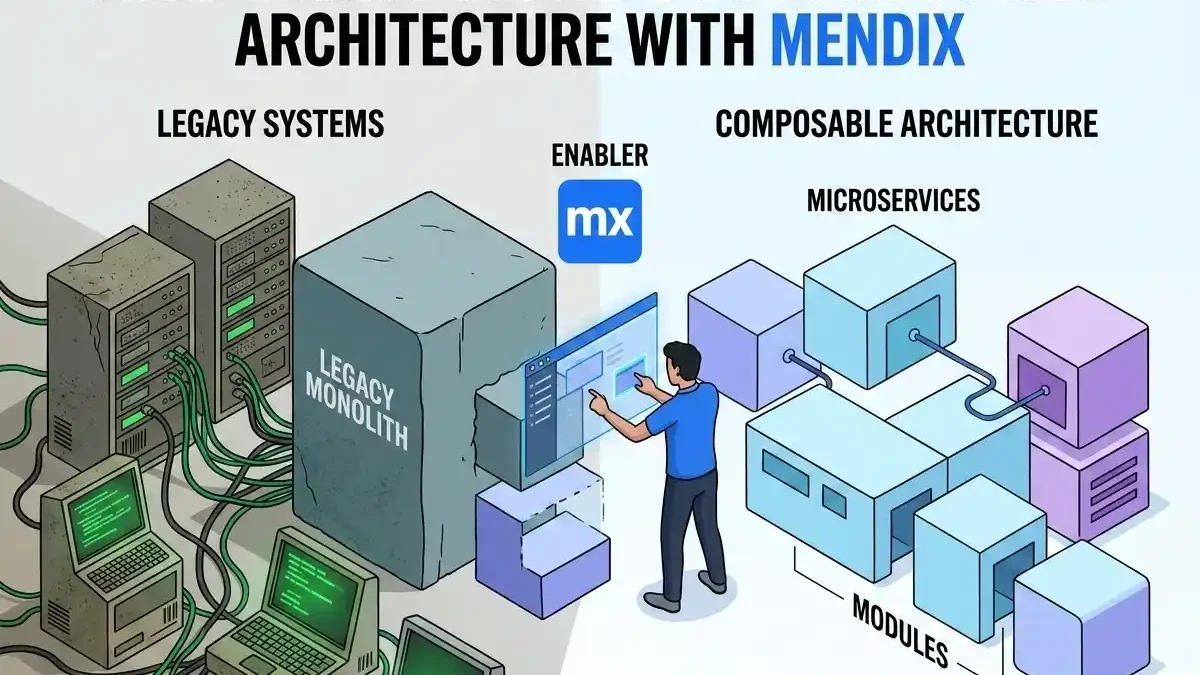
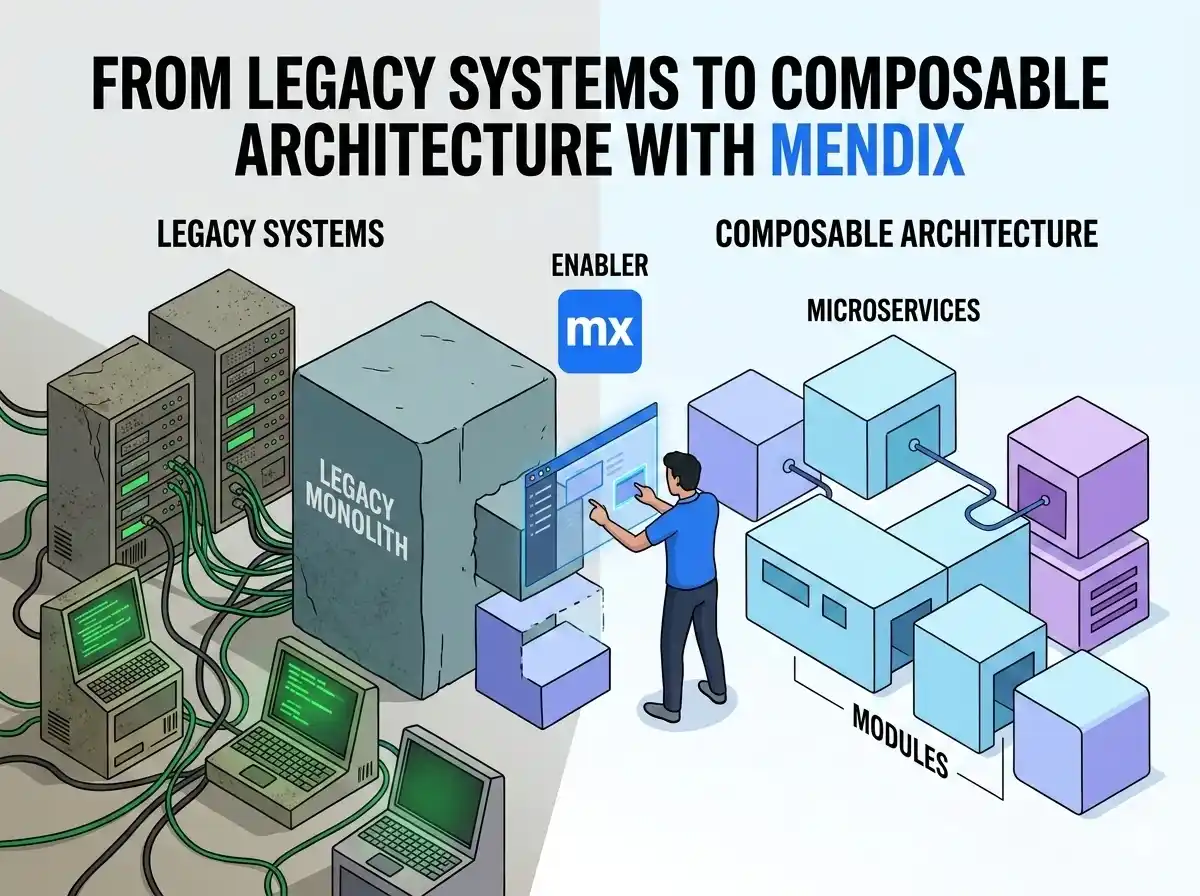
Mendix enables composable architecture by acting as a controlled orchestration layer around legacy systems.
Rather than replacing core systems immediately, enterprises can:
- Build modern user interfaces on top of legacy databases
- Expose legacy functionality through secure APIs
- Introduce automation workflows that span systems
- Gradually decouple tightly bound dependencies
This incremental strategy reduces modernization shock.
Legacy systems remain operational while new composable layers extend functionality.
The Role of API-First Design
Composable architecture depends on API-first thinking.
Enterprises transitioning from monolithic legacy systems must prioritize:
- Clear interface definitions
- Standardized integration patterns
- Version-controlled APIs
- Observability across service boundaries
Mendix supports structured API integration, allowing enterprises to wrap legacy systems in secure service layers without destabilizing core operations.
This approach avoids the “big bang” replacement model.
Governance in a Composable Model
One common misconception is that composable architecture reduces governance complexity.
In reality, it increases the need for disciplined oversight.
As modular services grow, enterprises must ensure:
- Consistent authentication mechanisms
- Standardized error handling
- Uniform logging frameworks
- Controlled release management
- Clear service ownership
Without governance, composability turns into fragmentation.
Organizations often engage structured Low Code Consulting initiatives during this transition phase to define architectural guardrails before scaling modular adoption.
Governance protects composability from becoming chaos.
Performance in Modular Architectures
Breaking monoliths into composable services introduces performance considerations.
Architects must carefully design:
- Transaction boundaries
- Inter-service communication latency
- Data consistency strategies
- Retry and fallback mechanisms
Composable systems can outperform monoliths – but only if designed with disciplined communication patterns.
Excessive synchronous calls across services can introduce new bottlenecks. Intelligent asynchronous workflows often provide better scalability.
Performance architecture becomes an intentional design discipline.
Scaling Composable Architectures Across the Enterprise
The true value of composable architecture emerges at scale.
Enterprises can:
- Launch new digital products faster
- Extend services into new markets
- Replace individual modules without rewriting entire systems
- Experiment safely within bounded service domains
Over time, legacy dependencies shrink as modular capabilities expand.
This controlled evolution allows organizations to modernize continuously instead of periodically.
Risk Mitigation Through Incremental Modernization
Large-scale system replacements fail not because they are technically impossible, but because they introduce too much risk at once.
Composable strategies reduce risk by:
- Allowing phased capability migration
- Testing new modules independently
- Maintaining stable legacy cores
- Replacing components gradually
Mendix supports this incremental path by enabling new services to integrate seamlessly with existing infrastructure.
Instead of rewriting everything, enterprises rewrite strategically.
Organizational Alignment and Operating Model
Composable architecture is not purely technical. It influences operating models.
Enterprises must align:
- Cross-functional product teams
- Platform governance groups
- DevOps capabilities
- Security oversight
- Compliance stakeholders
When modular architecture is paired with aligned team structures, innovation accelerates sustainably.
Disconnected teams implementing composability without coordination create architectural debt.
Long-Term Strategic Advantage
Composable architecture enables enterprises to:
- Adapt to regulatory changes faster
- Integrate emerging technologies without structural redesign
- Scale digital services globally
- Reduce dependency on singular legacy systems
Mendix Development Services often play a central role in this transition, enabling organizations to build modular service layers that align with enterprise modernization roadmaps.
Over time, legacy monoliths transition from central systems to specialized back-end components within a broader composable ecosystem.
This shift redefines how enterprises evolve.
Conclusion
Legacy systems are not the enemy. Rigidity is.
Composable architecture provides a strategic path forward – one that respects operational stability while enabling continuous modernization.
Mendix supports this transition by functioning as a structured orchestration layer around legacy environments, enabling enterprises to introduce modular capabilities without triggering systemic disruption.
Organizations that treat composability as an architectural strategy rather than a technology trend build digital ecosystems that evolve sustainably.
Teams such as We LowCode work with enterprises to design composable Mendix architectures that balance flexibility, governance, and long-term scalability – ensuring modernization efforts translate into enduring architectural resilience.
